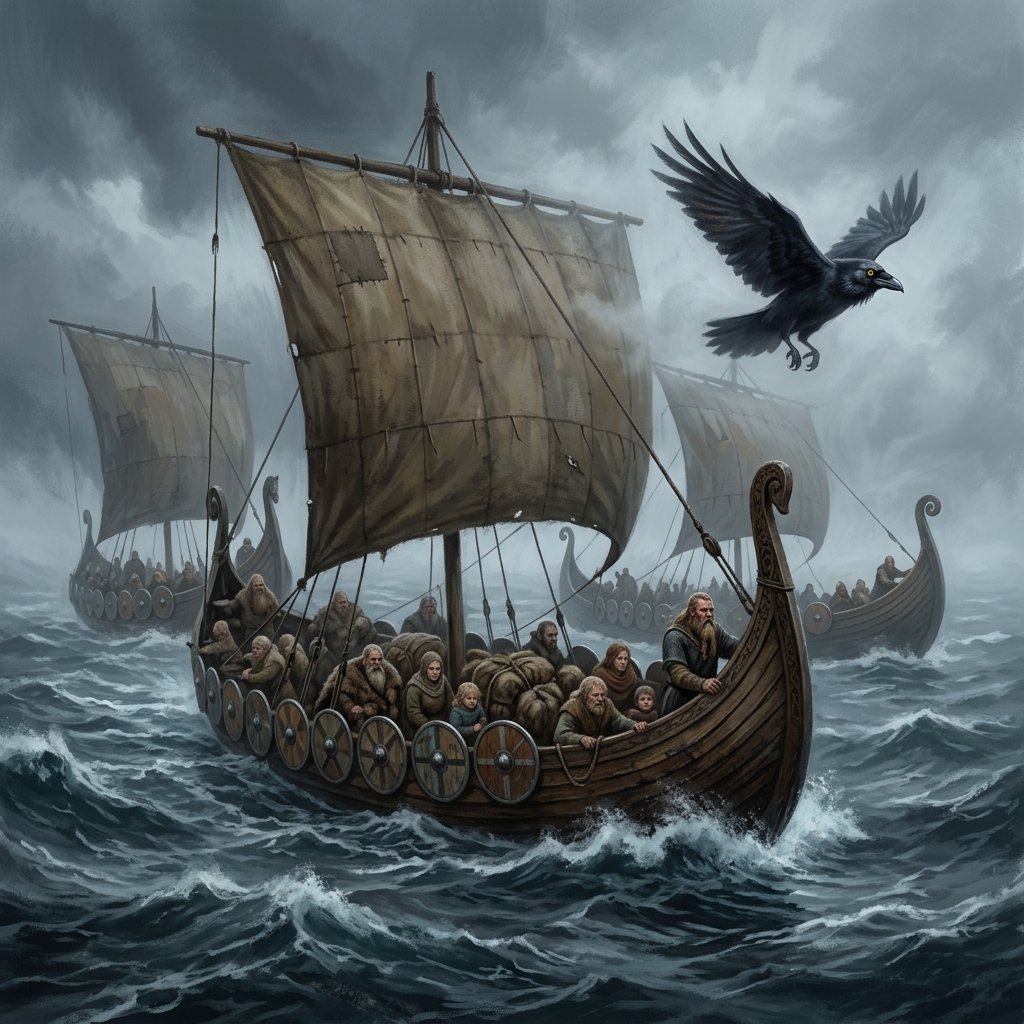
Three Ships Sailing South, Whispers of the Old God
This is not the history written by Romans on parchment. The history of the Romans is woven of ink and lies—exquisite, yet as cold as the marble of the Ravenna marshes, every stroke designed to conceal their deep-rooted dread of the northern wilderness.
This is a song carved upon bones and sung around campfires. It is the tale of those three oak ships, and how the Goths lost the North in their desperate struggle to survive.
Long ago, long before the name of the Roman Empire was ever uttered, the ancestors of the Goths dwelt in Scandza, a massive island at the northernmost edge of the world. It was a desolate realm cursed by ice, snow, and perpetual darkness. That year, a brutal winter descended earlier than ever before. In the dead of night, the glaciers groaned and cracked with deafening thunders, like the very bones of the earth freezing and snapping. Blizzards choked the forests, and the game perished in heaps upon the frozen snowdrifts, followed swiftly by their cattle.
Famine spread through the timber cabins like a plague. Mothers’ breasts dried and froze, unable to yield a single drop of milk; the cries of infants grew weaker day by day, until they fell silent, leaving only tiny, stiff corpses in the corners of the dark huts.
The elders gathered around the dying embers of the hearth, their faces hollow and gray. In the shadows, some cast desperate, ravenous glances at the dead children, their eyes glinting with the feral green light of starving beasts.
"My King," the aged priest rasped, his trembling hand pointing toward the white wilderness buried in snow, "we cannot cling to this ancestral soil any longer. If we remain, our entire nation will die out. The bloodline of the Goths will be utterly erased by the snow."
"But the sea beyond is a bottomless abyss!" someone wailed in despair. "The ocean is in a rage! To sail now is to seek our own graves!"
The legendary King Berig gazed upon his hollow-cheeked, dying people. He knew this was no choice; it was a desperate gamble between absolute extinction and a sliver of hope.
Berig knelt in the deep snow, slit his palm with a bronze dagger, and let his hot blood drop onto the frozen altar, pleading for the guidance of the gods.
At that moment, a massive, ancient raven flapped its ragged wings, descending heavily through the blizzard to perch upon the horse skull atop the altar.
It was an exceedingly strange bird. Its left eye was blind, leaving a dried, dark-red socket, but its right eye gleamed like polished obsidian, shining with ancient wisdom and the weight of ages. In mythology, the raven is the mortal guise of Gaut, the primordial ancestor god of the Gothic people.
The raven did not cry out. It merely stared at Berig with its deep right eye, then scraped three crude ship-like shapes in the snow with its claws, pointing toward the southern horizon.
Berig understood the sign. It was not a call to glorious conquest, but a grim command from the god: Depart, or perish.
To survive, the Goths frantically felled the tallest oaks along the frozen coast. They had no time for fine craftsmanship; they split the logs with crude iron axes and sealed the seams with pine resin and animal lard. Carrying their remaining grain and round shields onto the decks, they ushered their shivering women and children aboard, pushing the heavy vessels into the roaring waves.
It was the Sarmatian Ocean, a wrathful expanse of gray water where sudden tempests could easily shatter crude wooden hulls into splinters.
The first ship was named "The Sand Wave," its prow carved with the shape of a soaring eagle. The Ostrogoth ancestors on board gripped their oars, singing a solemn song of survival against the towering waves, every stroke a desperate duel with death.
The second ship was "The Forest Wave," its prow carved with a vigilant wolf. This vessel followed closely behind the king, its sides draped with fresh pine boughs to ward off the sea monsters of the deep. In the dark hold of this ship, a young Gothic boy clung to his mother; his descendants would lead this nation to sack Rome four centuries later.
The third ship was the heaviest and slowest. Its crew, weakened by hunger, rowed with sluggish strokes, falling further and further behind. The brothers on the first two ships looked back through the storm and laughed, shouting across the waves: "Gepids! Gepids! (the slow ones)."
Yet, driven by the sheer will to live, even the slowest ship fought its way across that sea of death. When the three ships finally made landfall on the southern coast of the Baltic Sea, the ancestors fell upon the sands and wept, kissing the earth because they had survived.
Yet, this was only the beginning of a centuries-long struggle. To find fertile lands where grain could grow, they began their long march southward.
It was a dark migration that spanned generations. They hacked their way through the endless black forests of Europe, fighting savage native tribes for every foot of soil, and waded through the treacherous Pripet Marshes. That vast, green expanse of rot and mire swallowed countless wagons and entire families.
Through those long centuries, the one-eyed raven always flew ahead of the column. It would perch on withered branches or cry out in the dead of night, guiding the lost through the treacherous bogs.
In this migration, the nation learned both cruelty and resilience. Elders who could no longer walk went willingly into the dark woods to freeze, leaving their rations for the children; infants were born beside the wheels of oxcarts, growing up on dry bread mixed with dust. They held but a single belief: press onward, and live.
At last, they stepped out of the final tree line. Spread before them was the boundless Scythian plain, shimmering under the Black Sea sun. The children of the three ships finally settled here, dividing into two great confederations—the Ostrogoths of the east and the Visigoths of the west.
For over a century, they carved out their domain with iron swords and long spears along the Black Sea—subduing neighboring tribes, and forging a powerful alliance through expansion and trade. Until the autumn of the year 375.
The waters of the Don River ran blood-red in the setting sun, like an open vein across the steppes.
The massive, one-eyed black raven—the ancient god Gaut—sat silently upon the branch of a dead oak by the riverbank.
With its dark obsidian eye, it gazed coldly toward the eastern horizon.
The eastern sky had changed. The once-blue vault was torn by pillars of black smoke rising from burning steppe settlements. Beneath the smoke, a faint, rhythmic tremor vibrated through the earth, like the thundering beat of ten thousand hooves against the chest of the world.
Across the river, a dark mass of shadows spilled over the horizon—the Hunnic horsemen, swarming like locusts.
At the vanguard of the horde, the Hunnic Khan Balamber reined in his squat, powerful warhorse at the eastern bank of the Don. He wore a helmet decorated with human bones, and his face was crossed with deep, scarred gashes.
Balamber did not order the attack. He merely sat motionless upon his horse, staring across the blood-red waters with the cruel, piercing gaze of a hawk, scanning the defenseless Gothic settlements.
The river flowed, the warhorses pawed the dirt, and the air hung heavy and silent, thick as unshed blood.
Arrows were nocked; blades were bared.
The old raven unfolded its ragged black wings, let out a harsh, rasping cry into the dying light of the sun, and flew toward the Visigothic camps.
A storm that would plunge the entire continent into fire and ruin was poised to break upon the banks of the Don.
📚 Historical and Mythological Annotations
1. Scandza Historical Context: A geographical term used by the 6th-century Gothic historian Jordanes in his work Getica, describing it as a "great northern island." In modern geography, this refers to the Scandinavian Peninsula (primarily southern Sweden). In the imagination of Roman geographers, this northern landmass was thought to be disconnected from the European mainland.
2. The Primordial Ancestor Gaut Mythological Context: Gothic mythology shares a common origin with Norse mythology (both belonging to Germanic paganism). Gaut (sometimes written as Gapt) is the legendary progenitor at the root of the Gothic royal lineages (the Amali dynasty). In Norse mythology, Gaut is a name for Odin (Wotan) in the Gothic tongue. Odin frequently wandered the mortal realm disguised as a one-eyed traveler, a gray-cloaked wanderer, or a raven, providing a strong mythological foundation for Gaut's appearance as the raven in the novel.
3. Runes Cultural Context: The ancient alphabet used by Germanic peoples, including the Goths, prior to their conversion to Christianity. These characters consisted mostly of straight lines, making them easy to carve on wood, bone, or stone. According to myth, Odin hung himself from the World Tree for nine days and nights to win the wisdom of the Runes. They were regarded not just as letters, but as vessels of magical power and prophecy.
4. King Berig Historical Context: The legendary first king of the Goths recorded by Jordanes. He is described as the leader who guided the Goths out of Scandza across the sea to the European mainland, landing at a place they named "Gothiscandza." His tale blends tribal memory with heroic myth.
5. Sarmatian Ocean Geographical Context: The Roman name for the **Baltic Sea** during the Empire. To the Romans of the time, this was an extremely cold, storm-swept, and mysterious sea marking the edge of the known world.
6. Etymology of the Gepids Historical Context: Jordanes records that during the crossing, the third ship lagged behind and was mocked by the others. Gepid is linked to the Gothic word Gepanta, meaning "slow" or "sluggish." The Gepids were close kin to the Goths and would later play a prominent role in history, known for their massive physical stature and their complex, shifting alliances and conflicts with the Goths along the Danube.
7. Pripet Marshes Geographical Context: A vast wetland system located along the modern border of Belarus and Ukraine, the largest marshland in Europe. In antiquity, it was a formidable barrier. The Goths were forced to traverse this region during their southward migration, losing countless lives and livestock—a trauma that remained deeply embedded in their tribal memory.
8. Don River Geographical & Political Context: Known to the ancient Greeks and Romans as the Tanais. In the 370s AD, this river served as the geopolitical boundary between the Ostrogothic Kingdom and the nomadic peoples of the eastern steppes (the Huns and the Alans). The crossing of the Don by the Huns marked a declaration of total war upon the Gothic world.
9. Balamber Historical Context: The first recorded king of the Huns according to Jordanes' Getica. Circa 375 AD, Balamber led a Hunnic-Alanic coalition across the Don, crushing the Ostrogothic Kingdom and triggering the subsequent mass migration of the Visigoths across the Danube, which served as the catalyst for the fall of the Western Roman Empire.