Broadsword and Toga: Chapter 1 - Sunset on the Black Sea, Sparks in the Tempest
內容版本:1.1最近更新:2026-07-14
分享文章:
The yellow sands drifted over from the eastern banks of the Don.
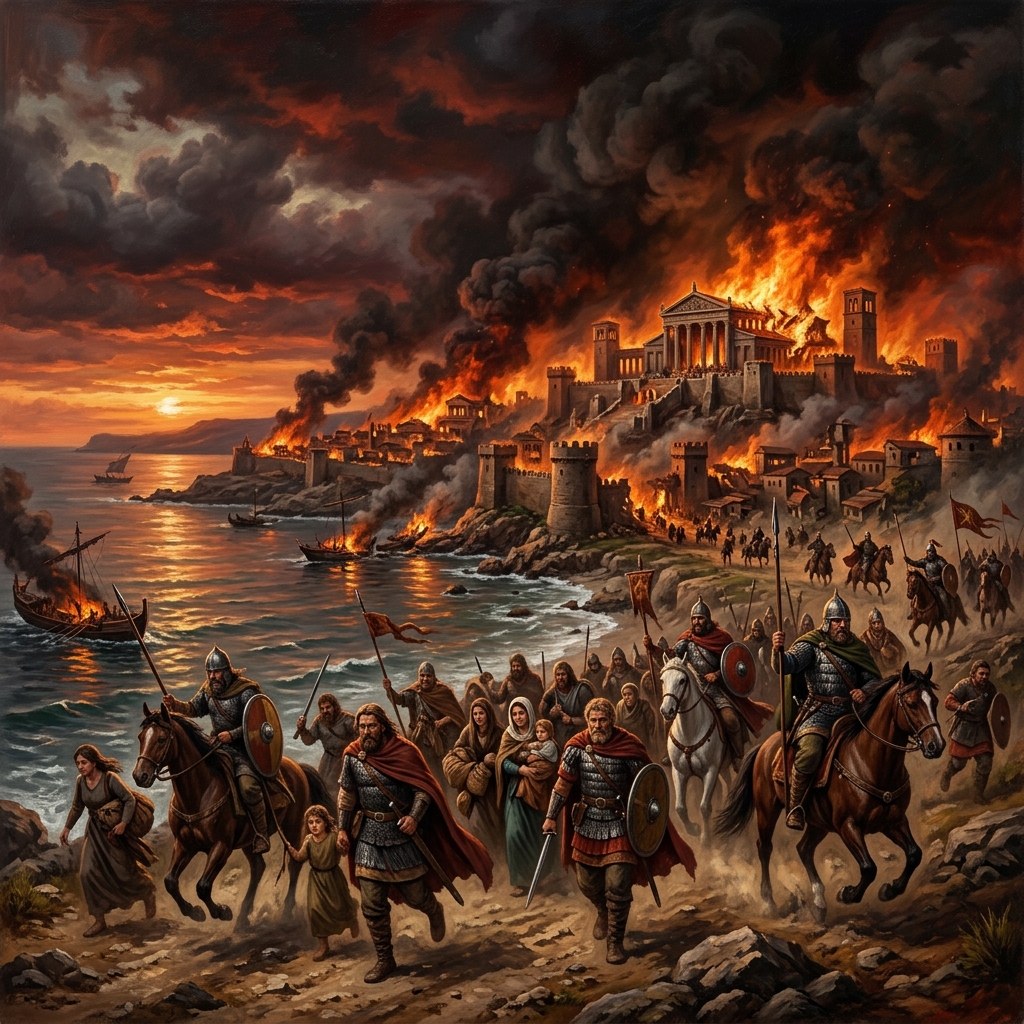
Sunset on the Black Sea, Sparks in the Tempest: In 375 AD, the Hunnic coalition crossed the Don, plunging Chersonesus, the capital of the Ostrogoths, into flames. The suicide of the old King Hermanaric in the temple marked the beginning of the Great Migration.
It was no ordinary wind and sand, but a dust storm thick with the stench of dried horse manure, scorched turf, and rotting flesh. In the memories of the Gothic people dwelling along the northern shores of the Black Sea, the Don had always been the boundary. To the west of the river lay the wheat fields they had cultivated for a century, the towering timber cabins built beside oak forests, and the sanctuaries dedicated to the thunder god Donar and the ancestor god Gaut. To the east lay the boundless Sarmatian steppe, a realm of nothing but the howling wind and the nomadic Alans who occasionally crossed the border to trade furs.
But this autumn, the Sarmatian steppe was torn asunder.
The massive, ancient raven—blind in its left eye, its right eye deep and obsidian—settled heavily upon the branch of a withered white oak on the western bank of the Don. In its gaze, the horizon across the river was no longer a rolling wave of gray-green grass, but had been replaced by a moving wall of black.
Horses. Countless horses.
They were smaller and stockier than the chargers bred by the Goths, their flanks caked in a hard crust of thick mud and sweat. And the creatures astride them, in the eyes of the Gothic sentries, hardly seemed human. Their bodies were short and hunched, their legs bowed like arches from a lifetime of gripping horse bellies. Their faces were broad and flat, lacking the high-bridged noses of the Germanic peoples, their skin weathered like old elm bark by the harsh sun and biting blizzards. Between their crude leather armor and bone ornaments, their eyes glinted narrow and wild like wolves.
These were the Huns. They were born on horseback, ate on horseback, and even slept on horseback.
At the vanguard of the massive cavalry wave, a black pony pawed the dirt restlessly. The man upon its back wore a leather cap adorned with a human skull, his face carved with deep, jagged scars that had opened and healed—the ancient ritual of the Huns, where elders slashed the cheeks of young boys with iron blades to stunt the growth of their beards.
He was Khan Balamber.
Balamber gazed across the wide waters of the Don, uttering no roar. He reined in his warhorse, slowly raising his right arm, a curved bone-hilted saber dangling from his fingers.
Ten thousand Hunnic horsemen reined in their mounts in unison. The steppe fell silent, save for the snorting of horses and the suffocating creak of leather. Then, Balamber pressed his fingers slightly downward.
It was the beginning of the storm.
The first wave of Huns crossing the river carried no heavy shields or long spears like the Goths were accustomed to. They clung tightly to their saddles, pressed low against their mounts, appearing from afar like a pack of black monsters swimming across the great river.
“In the name of the thunder god Donar! Loose! Let our iron points drink the blood of these demons!”
On the watchtowers of the western bank, young Gothic warriors raised terrified war cries. They drew back heavy oak bows, sending iron-tipped arrows whistling across the river, striking down several Huns who were swimming across. The waters of the Don were instantly stained with a jarring, dark crimson.
Yet, the fallen Huns did not inspire fear in their comrades; instead, they drew a sharp, dry whistling sound from the opposite bank.
When the Huns’ hooves finally struck the mud of the western bank, the Goths encountered a nightmare unlike any they had ever seen. Astride their galloping steeds, the stocky horsemen moved with a fluid grace as if bone-free, hanging off the sides of their mounts to evade arrows. Even in full retreat, they could twist in their saddles, drawing short composite bows made of horn and wood to drive bone-tipped arrows clean through the throats of Gothic warriors.
That bow was far shorter than the Gothic longbow, yet it was a masterpiece of lethal art. Constructed with a resilient birch core, backed by dense plates of antelope horn to withstand compression, and layered with thick animal sinew on the outside to store tension, the bow curved dramatically outward when unstrung. Once drawn, the explosive force it released could easily pierce Gothic chainmail. Furthermore, their bone-tipped arrows were carved with hollow cavities; in high-speed flight, they whistled and shrieked as air rushed through them, emitting a screeching sound like vengeful spirits. This terrifying "whistling arrow" not only tore through flesh but could instantly shatter the sanity of the defenders.
The Gothic infantry formations were formidable, standing behind interlocking shields and clad in iron chainmail, steadfast as a forest of oak. But the Huns refused to engage them head-on. Like a swarm of wasps drawn to blood, they gathered and scattered, circling the Gothic lines in a frenzied dance, pouring thousands of bone arrows into every gap in the defenses.
When the Goths, unable to bear the casualties, roared and broke formation to seek close combat, the Huns melted away like the tide; and when the exhausted Goths attempted to reform their lines, those terrifying horsemen would howl back, using lassos to drag isolated warriors under the churning hooves.
By the time the sun set, the meadows on the western bank of the Don were trampled bare of green. Broken spears stood in the mud, and iron mail lost its gleam in pools of blood.
The old raven spread its wings and took flight, letting out a hoarse cry against the blood-red sunset, winging its way westward toward the grand timber palace built upon the shores of the Black Sea.
There stood Chersonesus, the capital of the Ostrogothic Kingdom.
This grand city, nestled between the mountains and the sea, presented a striking fusion of civilizations. Originally a Greek stone-built colony, it boasted white marble colonnades in the Roman style, a weathered amphitheater, and thick, layered stone walls. Yet, when the Goths conquered it, they did not tear down these stone ruins; instead, atop the marble foundations, they erected massive timber-framed halls of rough northern oak. Dark pine resin coated the towering wooden roofs, and the ridges were carved with the menacing faces of ancestral gods and beast totems. Reflected in the deep blue light of the Black Sea and the setting sun, Chersonesus stood as both a shadow of the classical Greco-Roman empire and a monument to the wild vitality of the northern forests, like a giant woodland beast clad in marble armor.
Deep within the palace, upon a high throne, sat a man almost as old as history itself.
King Hermanaric. He was a hundred and ten years old.
His hair was dry and sparse, like remnant snow on winter fields; his eyes were sunken deep within sockets mottled with age spots, and his skin was dry and taut like an old parchment stretched over a skull. Yet, when his skeletal, calloused hands gripped the carved eagle heads on either side of the throne, the Gothic commanders standing below still held their breath in awe.
This old man was the pride of the Amali dynasty, the "Alexander of the North" who had led the Goths to conquer the Slavs and Finns, building a vast empire stretching from the Baltic Sea in the north to the Black Sea in the south.
But now, the old king’s breath rattled like a bellows, each gasp laden with the stench of decay and encroaching death.
“Your Majesty…”
A Gothic commander, covered in blood and with his right arm severed at the elbow, collapsed onto the cold marble floor. "The defensive line has utterly collapsed. General Fredbern is dead, his head hung from the saddle of the Hunnic Khan. And the Alans... the Alans have betrayed us.
"Those proud nomad riders of the steppes were crushed by the Hunnic demons with lassos and poisoned arrows on the eastern bank of the Don. The old Alan king slit his arm by the riverbank, swore a blood oath with Khan Balamber, and surrendered with the majority of his tribe. They have turned their horses around, offering the Huns every crossing, every path they learned while fighting by our side, and every blind spot in the defenses of Chersonesus! Now, these former allies serve as guides, riding their heavy warhorses and leading the Hunnic wolfpack straight toward us!”
A hushed gasp swept through the hall. The betrayal of the Alans meant that the steppe barrier, of which the Ostrogothic Empire was proudest, was gone.
Just then, the hurried, heavy clatter of iron mail echoed from outside the hall.
A young man clad in fine chainmail, his thighs and shoulder guards stained with dried blood, pushed past the panicked palace guards and strode into the hall. His face was cold and stern, his right arm bound in blood-soaked linen, yet his hawk-like eyes burned sharp and piercing in the firelight.
He was the youngest son of the old Alan king, a twenty-two-year-old commander—Saul.
“General Saul, should you not be on the western bank of the Don…” a Gothic elder asked urgently.
Saul ignored the elder, striding forward to kneel on one knee before King Hermanaric. His heavy armor struck the marble floor with a sharp metallic clang:
“King! The front is lost. My father and the Alan nobility compromised with the beasts, kneeling before Balamber. But I refused the Hunnic surrender order and personally slew their envoy who came to my tent! Now, alongside General Alatheus and General Saphrax, we are escorting the infant King Widerich. Leading the last three thousand Alan cataphracts who refuse to yield, I have fought my way west to the very gates of this palace!”
Saul raised his head, his dark brown eyes locked onto the old king. “Your Majesty, Chersonesus cannot be held. You must come with me now! My cavalry will escort you across the Dnieper River. We will ride west to the Dniester, into the forests to rally the Tervingi! As long as you, the monarch of the Amali, still draw breath, we can rebuild our forces and hold onto hope for a counteroffensive!”
King Hermanaric looked upon the blood-stained, spirited young commander before him, a complex emotion flitting through his eyes—a flicker of admiration for the young life, and a quiet resignation to the cruelty of fate.
He stood up slowly, resting his dry hands upon the longsword at his hip, and shook his head.
“Come with me, Your Majesty!” Saul urged anxiously.
“Flee?” Hermanaric let out a low, dry chuckle, his voice thin yet haughty. “Wolf of Sarmatia, you are young. Your steed is strong, your spear sharp, and your life has only just begun. Go, then. You can flee, and indeed you must.”
The old king stepped down from the throne, standing before Saul and patting his cold iron shoulder guard:
“But I have lived a hundred and ten years. My empire, my people, and my temples are all rooted in this soil. A king of the Amali, who has ruled the North for half a century, will never flee like a stray dog while his capital burns. If the empire of Gaut is destined to burn today, then in these flames, I shall leave that barbarian of the steppes a final keepsake.”
“But Your Majesty, to stay is death!” Saul stood, his voice rising.
“For an old man, death is no judgment, but a gift from the gods.” The king turned away, pointing toward the dark inner sanctuary deep within the palace. “Go, Saul, lead your cataphracts. Ride hard through the western forests and warn the Tervingi that the storm has come! Tell Fritigern, tell Athanaric, to grip their iron swords! The steel of Goth and Alan... must not break today!”
Saul gazed at the old king’s withered frame, standing tall and immovable as a mountain of stone. Pain and reverence washed over the young general. He knew that nothing could bend the will of this hundred-year-old sovereign.
Saul stepped back three paces, slowly drawing the saber from his waist and pressing the hilt to his forehead, saluting the great monarch with the highest honor of an Alan warrior.
“May the winds of heaven ever accompany your soul, great King.”
Saul turned on his heel, his wolfskin cloak snapping in the wind, and strode out of the hall. In the marble courtyard outside, three thousand armored Alan mounts and thousands of Ostrogothic riders snorted restlessly in the dark. General Alatheus and General Saphrax were already mounted, the latter cradling the crying infant King Widerich wrapped tightly in furs. With a sharp whistle from Saul and the two generals, the armored torrent carrying the last embers of the Ostrogoths plunged into the western night, riding hard.
Meanwhile, on the eastern horizon, countless fires merged into a single sea of flames. The Hunnic wolfpack had reached the very walls of Chersonesus.
A deathly silence hung in the sanctuary, where only a few tallow lamps cast a dim, pale light.
Hermanaric pushed open the heavy bronze doors of the sanctuary alone and stepped inside.
In the center stood the statue of Donar, the thunder god, holding his short hammer of lightning; to the right was the one-eyed, cloaked Gaut, the primordial ancestor; and to the left was Tyz, the war god of iron blood and law, holding his spear.
The old king knelt before the obsidian-inlaid eyes of Donar. With his trembling right hand, he drew his long broadsword from his hip, slitting the palm of his left hand with its sharp edge. He allowed his hot blood to drop onto the altar before the statue, the red stream trickling slowly along the ancient runic carvings.
“Donar, Lord of Thunder in the heavens, guardian of the Amali,” the old king’s voice echoed in the sanctuary, carrying a desperate plea, “the demons of the East have crossed the boundary. They trample your lands and burn your sacred groves. You once promised King Berig that as long as the iron swords of the Goths remained sharp, your thunder would forever crush the invaders. Loose your thunder! Strike down those monsters who ride the wild beasts!”
The sanctuary remained deathly silent. The blood on the altar gradually congealed, and the wooden deity stood cold and unfeeling in the dim light. There was no wind, no thunder, only the distant, muffled cries of desperate Gothic women echoing from outside the palace gates, drawing closer by the second.
At that moment, the bronze doors of the sanctuary were violently thrown open.
An old general, engulfed in flames, rolled into the chamber. Several bone-tipped arrows protruded from his chest, and he convulsed, collapsing into a pool of blood. Behind him, the sky outside glowed with raging fires, and thick smoke rolled in, accompanied by the heavy, slow footsteps of someone stepping into the sanctuary.
Hunnic archers fanned out like specters near the bronze entrance, their composite bows drawn taut and aimed at the altar. However, a man wrapped in a wolfskin cloak, his flat face crossed with terrifying scars, stepped forward, raising a hand to signal his men to lower their weapons.
He was Khan Balamber.
Balamber stepped through the pooling blood, surveying the ancient temple. At last, his gaze settled upon the old king and the four-foot-long blade of "Amali's Pride." A wild, cruel smile tugged at the corner of his lips:
“Hermanaric. I have heard your name; the northern lands once trembled before your iron sword. But you are too old now—so old that even your gods do not bother to answer your call.”
The old king rose slowly, his withered frame trembling with fury. He gripped the heavy broadsword with both hands, his voice as chilling as cold iron: “Balamber. The blood of the Amali never bows to beasts. You crossed the Don bringing only ruin and injustice. The gods will punish you in the end.”
“The gods?” Balamber laughed aloud, pointing at the three wooden statues in the hall. “You mean these dead logs? You Germanic people are truly foolish, building your wealth within walls you cannot move, and placing your faith in wood that cannot stir. On our steppes, walls are but graves for the living! Where the wind blows, our hooves follow, and the earth itself is our altar!”
“Then let my iron sword measure the head of you, beast!”
Hermanaric let out a roaring war cry that sounded like thunder. In that single instant, the hundred-and-ten-year-old monarch seemed to reclaim the youth and strength of thirty years past. Tightening his muscles, his longsword cut a crimson arc through the air, descending upon Balamber's head with the force of a thunderbolt!
Balamber’s pupils contracted. He had not expected this frail old skeleton to unleash such terrifying power. Dodging with the swiftness of a lone wolf of the steppes, he drew the curved saber adorned with wild beast bone from his waist.
Clang!
Sparks erupted violently in the dark corners of the hall. The broadsword and curved saber clashed heavily in mid-air, the screeching grind of steel nearly shattering the eardrums. Pressing forward with the momentum of his slashes, the old king swung with wide, sweeping strokes, each blow carrying a desperate resolve to perish together. The heavy broadsword whistled through the air, forcing the prime-aged Balamber to retreat three paces, and even chipping the edge of his curved blade.
But a hundred-and-ten-year-old body could not defy the physical limits of flesh after all. After a few exchanges, the old king’s breathing grew erratic, and every stride he took was accompanied by the dry, grinding creak of his joints.
Balamber seized this weakness with hawk-like precision. With a low growl, he ceased to block the broadsword head-on. Instead, ducking low, he slid like a venomous serpent into the old king’s flank. The curved blade flashed cold steel, drawing a fatal arc through the air that sliced clean through the tendons of the old king’s right wrist.
The broadsword slipped from his grasp, clattering heavily onto the marble tiles. In the same motion, Balamber delivered a heavy kick to the old king's chest.
The old king grunted, stumbling back several paces until he slammed heavily against the pedestal of the statue of Gaut. His skeletal fingers clawed desperately at the marble, trying to stand once more, but the blood flowing from his left hand and the agonizing pain in his right left him barely able to lean against the statue, gasping for air.
“Kneel, Hermanaric. Bow to the Eternal Blue Sky, and call me father. I may yet let you keep your crown, and allow your children to herd cattle for me along the Dnieper. Otherwise, my iron hooves will grind your empire into sand, and utterly sever the lineage of the Amali.”
The old king looked up, staring at Balamber. There was no fear in his single eye, only endless mockery and pride. Slowly wiping the blood from his lips with his left hand, he suddenly began to chuckle:
“Bow to the Eternal Blue Sky? Bow to a barbarian who rides a pony and eats raw meat in the mud? Balamber, you may conquer the land, but you will never conquer the soul of an Amali. The iron sword of the Goths breaks only on the battlefield; it never signs a surrender.”
With that, the old king reached out with his left hand, gripping with deathly strength the hilt of "Amali's Pride" embedded in the stone pedestal of the altar.
Balamber’s expression changed slightly, and he reached out in an attempt to stop him.
Yet, the old king closed his eyes, summoning the final measure of his will and dignity, and threw himself heavily upon the tempered steel broadsword that had accompanied him throughout his life.
Squelch!
The sharp blade pierced through the mail coat, driving straight into the aged, proud heart of the king.
Blood sprayed like a spring onto the pedestal of the statue of Gaut.
Hermanaric’s body slid slowly down the blade, his hands still gripping the hilt with a deathly tightness, his eyes wide open, collapsing proudly amidst the flames of the sanctuary.
A dead silence fell over the Hunnic warriors who had rushed into the sanctuary. Looking upon this hundred-year-old king who had refused to bow even in death, choosing suicide to declare his unyielding spirit, they bowed their heads one by one, placing their hands over their chests in salute.
Balamber gazed at the corpse of the old king, and after a long silence, let out a low sigh:
“He was a true warrior. Leave his sword in his hand. Do not disturb his body.”
At that moment, the wooden dome of the burning palace finally gave way under the intense heat, collapsing with a deafening crash. Roaring fire and billowing smoke completely consumed the statues, the old king, and the Amali palace that had ruled the North for a century.
Yet the blade of "Amali's Pride," embedded deep in the stone pedestal of the altar, was not melted by the great fire. It emitted a low, runic wail amidst the licking flames, as if waiting for some future moment to be regained once more by another Gothic king, to slice away the veil of the Romans and strike down their mortal enemies of the yellow sands.
Chersonesus, in the fading light of the Black Sea sunset, dissolved into a crimson sea of fire.
Outside the billowing smoke and fire, the old raven, blind in its left eye, circled three times in the sky.
It perched upon a charred stone column that had not yet collapsed beside the ruins of the palace. The firelight reflected in its obsidian right eye, staining the black pupil a blood-like, bright red.
Then, the old raven let out a hoarse cry, sounding almost like a sigh.
Its silhouette warped slightly amidst the thick smoke. The bird's body, originally covered in mottled feathers, lengthened in the shadows of the firelight, gradually transforming into a hunched, one-eyed old man wrapped in a tattered gray cloak.
The old man leaned against the charred column, gazing at the sanctuary that had been reduced to ashes in the inferno.
“Donar’s hammer is broken; Tyz’s law is turned to ash,” the one-eyed old man murmured in a raspy voice audible only to himself. There was no sorrow in his single eye, only a boundless desolation. “Hermanaric, you sacrificed to the iron sword with blood. But you did not know that while the iron sword can conquer the plains, it cannot hold back the sands of fate.”
The old man turned, turning his back on the Black Sea boiling in the sunset and fire, and walked toward the west.
Behind him, upon the scorched earth of the Ostrogoths, countless displaced refugees, carrying the old and leading the young, fled in panic toward the forests of the west and south. The torrent of the Great Migration had been completely unleashed by this storm, trailing in the wake of the old god.
The one-eyed old man pulled down the hood of his gray cloak, concealing his blind left eye, and stepped line by line into the dark night.
“Go, children of the three ships,” his whisper scattered in the wind. “Go south... and before you are consumed by the flames, use your broadswords to carve your names upon the stone.”
📚 Historical and Mythological Annotations
1. Hermanaric (Hermanaric / Ermanaric)
Historical Context: The legendary king of the Amali dynasty of the Ostrogoths, who ruled the vast Ostrogothic Kingdom (Oium) from around 350 to 375 AD. Roman historian Ammianus Marcellinus records that he was a highly aggressive and warlike monarch. At a hundred years of age, unable to withstand the sudden invasion of the Huns and faced with tribal division and betrayal, he committed suicide in grief and anger. His death directly led to the collapse of the Ostrogothic Kingdom and triggered the chain reaction of the Great Migration of barbarian tribes.
2. Amali's Pride (Amali's Pride)
Cultural Context: The Amali dynasty was one of the two most noble Gothic royal lineages (the other being the Balti dynasty of the Visigoths). In Jordanes' accounts, the Amali were regarded as descendants of the "Anses" (demigods), symbolizing legitimacy and divine right. The broadsword used by the old king in the novel represents the dignity and iron will of this ancient dynasty.
3. Thunder God Donar (Donar)
Mythological Context: Donar is the Old Germanic name for Thor, the god of thunder. In Gothic pagan belief, he was the powerful protector who presided over lightning, war, and agriculture. Prior to their conversion to Arian Christianity, the Goths sacrificed weapons and blood to Donar to pray for victory in battle.
4. War God Tyz (Tyz)
Mythological Context: Tyz (also written as Tiwaz) was the god of war and justice in ancient Germanic mythology (corresponding to Tyr in Norse mythology). He represented fair duels, oaths, law, and valor on the battlefield. The Germanic peoples used the ᛏ (T-rune) from the runic alphabet to represent him, often carving this symbol onto sword blades to seek the war god's blessing.
5. Chersonesus (Chersonesus / Ostrogothic Seat)
Geographical and Cultural Context: Located in the southern part of the Crimean Peninsula (near modern Sevastopol). The city was founded by ancient Greek colonists in the 5th century BC, and later became a key military stronghold and protectorate of the Roman defense lines during the Empire. It featured extensive classical ruins, such as white marble colonnades, stone defense walls, and a circular amphitheater. Following the southward migration of the Goths in the 3rd century AD, the Ostrogothic tribe settled here (the Crimean Goths) and established close trade and political ties with the city. Using their superb woodworking skills, the Goths erected massive oak-trussed halls directly atop the Roman stone foundations, forming a unique architectural synthesis of "marble foundations and wooden temples." In the novel, this serves as the symbol of Ostrogothic royal power until it was captured and burned by the Hunnic coalition in 375 AD.
6. Bone Arrowheads and Whistling Arrows (Bone arrowheads and Whistling arrows)
Literary and Archaeological Context: The 4th-century Roman historian Ammianus Marcellinus recorded in his work Res Gestae that the early Huns' arrowheads were not made of iron, but were "tipped with sharpened bone, joined to the shaft with wonderful skill." In the early stages of their invasion in the 370s AD, the nomadic Huns, limited by metallurgical conditions on the steppes, made extensive use of bone or antler points. They carved hollow cavities into the tips, causing them to screech as air rushed through them during flight (known as whistling arrows or mingdi), primarily for tactical signaling and psychological terror. By the time of Attila in the 5th century, the Huns had acquired large amounts of iron through conquest and trade, gradually shifting entirely to three-winged iron arrowheads.
7. Cheek Scarification (Cheek scarification / Face slashing)
Historical and Anthropological Context: Ammianus Marcellinus records that shortly after birth, Hunnic male infants had their cheeks deeply gashed with iron blades by their elders. As the wounds healed, the thick scar tissue completely destroyed the hair follicles, preventing beards from growing in adulthood. This custom was widespread among early Huns. Besides serving as a mark of tribal identity and warrior class, their scarred, hairless faces presented a terrifying appearance that acted as psychological intimidation on the battlefield.
8. Tervingi and Greutungi (Tervingi and Greutungi)
Historical and Linguistic Context: On the eve of the Great Migration in the 4th century AD, the Goths did not call themselves "Ostrogoths" and "Visigoths"; these terms were popularized by Roman historians and later writers in the 5th and 6th centuries. At the time, the Ostrogoths called themselves the Greutungi, meaning "dwellers of the sandy shores," while the Visigoths referred to themselves as the Tervingi, meaning "forest people." These names were closely tied to their respective settlements along the sandy shores of the Black Sea and the forests of Dacia. Therefore, in the novel, Hermanaric refers to the Visigoths north of the Danube as the "Tervingi."
9. Saul and Alan Cataphracts (Saul and Alan Cataphracts)
Historical and Military Context: The Alans were an Iranian-speaking nomadic people originating from the Caucasus and the Don steppe, renowned for their formidable heavy cavalry (cataphracts). Both horse and rider were clad in iron armor, wielding long spears (contus) to execute devastating charges, making them one of the most lethal cavalry units of late antiquity. Historically, Saul was a real Alan general. Following the subjugation of his tribe by the Huns, he led his followers in escape to the west. As a brilliant heavy cavalry commander, he played a critical role in the historical turbulence of the Great Migration.